What Do MOT Testers Check for Rust and Welding Repairs?
A lot of drivers know that rust can fail an MOT. Far fewer understand exactly what MOT testers are looking for, which areas of the vehicle they assess most carefully, and what the difference is between rust that causes a failure and rust that results in an advisory. That uncertainty can make preparing for an MOT with a corroded vehicle feel like guesswork.
It doesn’t have to be. MOT testers work to a defined set of criteria set out by the DVSA. Those criteria are specific, consistent, and predictable — if you understand what a tester is looking for, you can make an informed decision about whether your vehicle is likely to pass, and what needs to be addressed before the test. This guide explains how MOT testers assess structural rust and welding repairs, which areas they focus on, and what the practical implications are for vehicles with known corrosion issues.
The Basis for MOT Rust Assessments
The MOT test is carried out to the DVSA’s inspection manual, which sets out specific categories of defect for body and structure. In the context of rust, testers are primarily looking for corrosion that has weakened the structural integrity of the vehicle to the point that it poses a safety risk.
Rust is categorised in terms of how much it has penetrated the metal. Surface corrosion — rust that is on the surface of the metal but hasn’t penetrated through — is generally not a failure point in isolation, though it may be noted as an advisory if it’s advancing toward a structural zone. Through-rust, where the corrosion has perforated the metal entirely, is treated much more seriously, particularly in prescribed areas of the body structure.
Defects are classified as Minor (advisory only), Major (requires repair before vehicle is legal to drive), or Dangerous. For structural rust in key areas, the relevant defect is typically Major — the vehicle fails and must not be driven until repaired and retested.
The Key Areas MOT Testers Inspect for Rust
MOT testers focus their rust assessment on areas that are load-bearing or that contribute directly to the structural integrity of the vehicle. The primary zones checked for corrosion are:
- Sills. The inner and outer sills run the length of the vehicle below the door apertures and form a significant part of the structural backbone of most monocoque-bodied cars. Rust here — particularly where it has caused perforation or severe weakening — is one of the most common structural failure reasons. Inner sills are often more compromised than outer sills because they’re less visible and drain poorly.
- Floor pan and floor members. The floor of the vehicle carries significant structural load and is assessed for corrosion, particularly around the sill attachment zones and the central tunnel. Through-rust in the floor pan — especially in sections adjacent to sill attachments — is typically a failure.
- Wheel arches. The inner and outer arch panels are assessed for rust, particularly where the arch meets the sill or connects to the floor pan. Outer arch rust alone may not always be a failure, but arch rust that has tracked into adjacent structural sections usually is.
- Chassis rails and crossmembers. For vehicles with a separate chassis — vans, older 4x4s, light commercials — the chassis members are assessed directly. Severe corrosion or perforation of a chassis rail is a serious failure. Even on monocoque cars, the front and rear subframe mounting areas and any chassis-adjacent structure are checked.
- Suspension and steering attachment points. Any metalwork that directly supports suspension components or steering geometry — including subframes, strut towers, and suspension turrets — is assessed for corrosion. Rust here is treated as especially serious because of the direct safety implication.
- Seat belt attachment points. Seat belt mounting points are structural fixings that must be in sound metal. Rust at or around these points will typically cause a failure.
- Tow bar mounting structures. As covered in a separate guide, tow bar mounts are checked for structural integrity as part of the underside inspection.
How Testers Assess the Severity of Rust
MOT testers use a combination of visual inspection and physical probing to assess the condition of structural metal. The process involves:
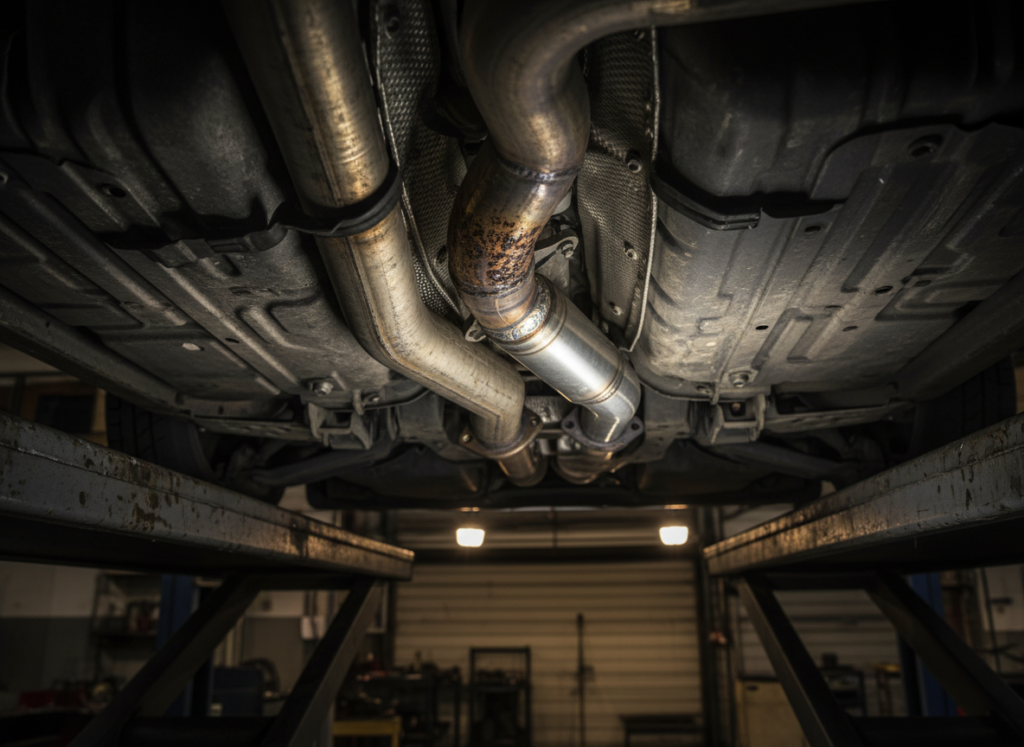
- Visual inspection from below. The vehicle is raised on a lift and the underside is examined. Testers look for visible rust, scale, and corrosion products, as well as areas where underseal or paint has been lifted by rust forming beneath it.
- Physical probing with a corrosion tester. Where rust is visible or suspected, the tester uses a specialist probe to check the depth of corrosion. The probe is applied to the metal with a controlled amount of force to determine whether the metal has lost enough thickness to constitute a structural failure.
- Assessment of location and proximity to prescribed zones. Rust that might be an advisory in a non-structural panel can be a failure if it’s within a zone the DVSA defines as prescribed — i.e., directly contributing to structural integrity.
- Visual check of prior repairs. If a vehicle has had welding repairs, the tester will check whether those repairs have been carried out properly. A weld that was done using inappropriate materials, or that doesn’t cover the full extent of the corrosion, may not pass if the tester isn’t satisfied it has restored the structural integrity of the area.
The standard for failure is whether the corrosion has “seriously weakened” the structure. Testers apply professional judgement alongside the DVSA criteria — which is why some vehicles with similar-looking rust may have different outcomes at different MOT stations. The underlying criteria, however, are the same.
What Makes a Welding Repair Pass or Fail an MOT?
MOT testers also assess welding repairs that have been carried out. Not all weld repairs are equal, and a poorly executed repair can itself be a reason for failure. Testers look at:
- Whether the repair covers the full extent of the corrosion. If rust extends beyond the welded section, the repair may be considered incomplete. Cutting back rust until clean metal is found — not just until the worst-affected area — is essential.
- Whether the repair material is appropriate. Filler, fibreglass, or structural adhesive in a prescribed zone will not pass an MOT. The repair must be in steel, welded in place by a competent welder.
- Whether the weld itself is sound. A weld that is porous, incomplete, or that has not achieved proper fusion with the base metal may be probed and assessed as inadequate. Visual checks by experienced testers can often identify poor weld quality.
- Whether the repair has restored structural integrity. The weld repair needs to bring the affected area back to a standard where it can carry the loads it’s designed for. Thin patch repairs that cover small areas over widespread corrosion are not sufficient.
This is one of the reasons why we take a thorough approach at Star Welding Mansfield. A repair that isn’t done properly doesn’t just waste your money — it may still fail the MOT, and it can give a false sense of security about the vehicle’s structural condition.
Areas Where Rust Is Easily Missed Before an MOT
Some areas of corrosion are straightforward to spot. Others are consistently missed by drivers — and sometimes by less thorough garages — until they become a problem at MOT time. The places where rust tends to hide until it’s become significant include:
- Inner sills. The inner sill runs inside the outer sill panel and is typically not visible without getting under the vehicle. It’s often the first section to corrode seriously because it sits in a drainage channel and retains moisture. Outer sills can look clean while the inner sill is significantly compromised.
- The base of the A, B, and C pillars. Where pillars meet the sill at their base, moisture collects in the joins and corrosion can advance inside the pillar cavity before becoming visible externally.
- Behind wheel arch liners. Plastic arch liners trap moisture against the inner arch and the sill. Rust behind them can be extensive before the liner is removed and the metal examined.
- Under underseal. Underseal applied over existing surface rust can mask ongoing corrosion. If the underseal is more than a few years old on a vehicle with known corrosion history, it’s worth having it properly assessed rather than assuming it’s still doing its job.
- Inside box sections. Chassis rails, crossmembers, and other boxed structural sections corrode from the inside when internal drainage holes block and moisture accumulates. External surfaces can look acceptable while significant internal corrosion is present.
The Value of a Pre-MOT Welding Assessment
If your vehicle has known rust issues, a pre-MOT assessment by an experienced welding specialist is a sensible step before putting the car in for its test. There are several practical advantages to this approach:
- You know what to expect before the test. If there are issues that will cause a failure, it’s better to know about them before you pay for an MOT that the vehicle will fail.
- You have time to plan the repair. An MOT failure with a short turnaround window can create pressure to use whoever is available. Knowing in advance allows you to use a specialist you trust, without time pressure.
- A specialist can spot what an MOT tester will probe. An experienced welding specialist — particularly one who understands MOT criteria — will often identify the areas that a tester will focus on and can give you a realistic picture of whether the vehicle is likely to pass.
- Repairs can be completed and the vehicle can be taken straight for MOT. Rather than failing, having the vehicle recovered or parked up while waiting for a repair slot, and then going back for a retest, the whole process is more efficient when addressed proactively.
At Star Welding Mansfield, we carry out welding assessments and can advise on the likely MOT implications of any corrosion we find. We don’t test vehicles — that happens at an MOT station — but we can give you a clear, experienced view of the structural condition of your vehicle and what it would need to pass.
What Happens After a Structural Welding Repair?
Once welding repairs have been completed, the vehicle can be taken back for an MOT retest (if it had already failed) or for its standard test if the repairs were done proactively. At the retest, the tester will check the areas that were noted as defects and confirm whether the repair meets the required standard.
It’s worth being aware that a retest may not always cover the full vehicle — depending on the type of retest and timescales — so if any new issues have become apparent since the original test, it’s worth discussing those with the MOT station before the retest takes place.
After welding repairs, it’s also sensible to protect the repaired areas from future corrosion. We apply rust treatment and seam sealer where appropriate as part of our standard process, but longer-term protection — waxoyl, cavity wax, or similar products applied to vulnerable areas — is worth considering on vehicles with a known corrosion history.
For a full picture of our MOT welding capability, see our MOT welding and rust repair service page. For sill and floor pan work, the sill, arch and floor pan repairs page covers the most common structural failure zones in more detail.
Before you book anyone to carry out the repair, it is worth understanding what a coded welder is and what to ask them — the MOT manual is specific about which repair methods a tester must reject.
Need a Welding Assessment Before Your MOT in Mansfield?
If you’re unsure whether your vehicle’s rust will cause an MOT failure, or if you’ve already received a failure or advisory for structural corrosion, Star Welding Mansfield can help. We’re a specialist welding workshop in Mansfield Woodhouse, NG19 9BL, with experience in MOT-related structural repairs across a wide range of vehicles.
We’ll give you a straightforward assessment of what we find, explain what is and isn’t a concern from an MOT perspective, and carry out repairs to a standard designed to meet MOT requirements. We don’t do rushed or cosmetic fixes — if we weld it, it’s done properly.
Contact us to book a welding assessment at our Mansfield workshop.
Related reading: How Car Rust Spreads and When Welding Repairs Are Needed.