Stainless vs Mild Steel Exhausts: Why a Stainless Steel Exhaust Repair Isn’t the Same Job
Hold a fridge magnet against your exhaust. If it grabs, you have learned something useful in about two seconds — and if it slides off, you have learned something more useful still. Almost every guide to fixing a blowing exhaust talks about the part. Hardly any of them talk about the metal, and the metal is what decides whether the repair is straightforward, awkward, or not worth attempting at all.
This guide explains how mild steel, aluminised steel and stainless behave differently once they start to fail, how to work out which one is under your car, and what actually changes in the workshop when a stainless steel exhaust repair is on the ramp instead of a mild steel one. Written by the coded welders at Star Welding Mansfield in Mansfield Woodhouse, Nottinghamshire.
Published: 27 October 2026 | Updated: 27 October 2026 | Author: Star Welding Mansfield Team
Quick Answer: Is a Stainless Steel Exhaust Repair Different?
Yes. Stainless needs a different filler wire, a different shielding gas and far more heat control than mild steel. It also fails differently — instead of thinning evenly into pinholes, stainless tends to crack at joints and heat-affected zones while the surrounding pipe still looks healthy. That changes what can be patched and what has to be cut out and replaced.
Three Metals, Not Two
Drivers tend to divide exhausts into “standard” and “stainless”. In practice a car in a Nottinghamshire workshop is usually wearing one of three things.
Mild steel is the cheapest and the shortest-lived. It rusts from the inside out as much as the outside in, because condensation sits in the system every time a cold engine is run for a short journey and never gets hot enough to dry out.
Aluminised steel is mild steel with an aluminium-silicon coating. It is what a great many factory systems are made from, and it behaves like mild steel with a head start: it lasts noticeably longer, then fails in much the same way once the coating is breached by a stone chip, a scrape or a clamp.
Stainless is not one material either. The magnetic, chrome-based grades are common on original-equipment systems, and the non-magnetic chrome-and-nickel grades turn up more often in aftermarket and performance systems. Both are called stainless. They do not weld identically, and neither of them is rust-proof.

The Magnet Test — and Why It Only Half Works
A magnet is the fastest first check you can do yourself on a cold exhaust. If it sticks firmly, you are almost certainly on mild or aluminised steel, or on a magnetic stainless grade. If it barely holds or slides straight off, you are on a non-magnetic stainless.
The catch is that a great many original systems use a magnetic stainless, so a magnet that sticks does not prove the pipe is mild steel. The other clues matter: aftermarket stainless is usually thicker-walled, brighter under the surface dirt, and often has visibly different welds — neat, rippled TIG beads rather than the fast machine seams on a factory pipe. A mild steel section that has been on a British road for years is usually flaking in layers rather than pitting in spots.
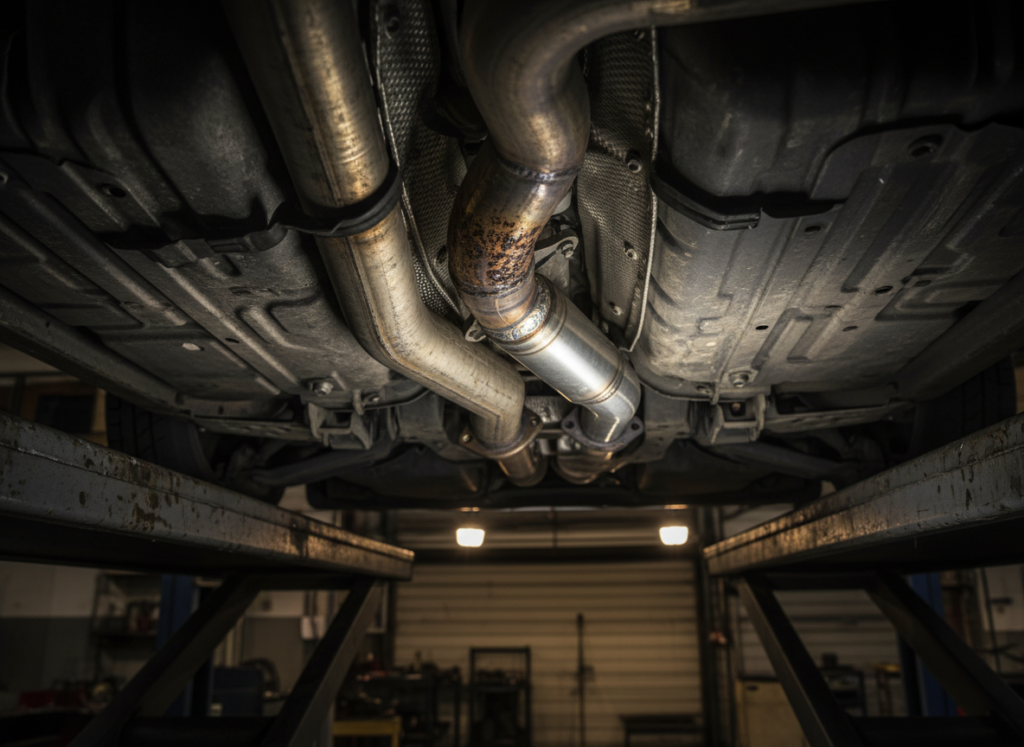
None of this is guesswork once the car is on a ramp. A quick scrape through the surface corrosion tells a welder more than any of it, which is why an assessment comes before any promise about what can be saved.
They Fail in Completely Different Patterns
This is the part most guides skip, and it is the part that decides the job.
Mild and aluminised steel thin out. Corrosion works across a broad area, the wall gets steadily weaker, and eventually a pinhole appears — usually at the lowest point of a silencer or on the underside of a bend where water sits. The metal around that hole is often still thick enough to weld to, which is why a patch or a new section can be let in successfully. Our guide to whether a corroded pipe can safely take a weld goes through how that call is made.
Stainless does something else. It resists general surface corrosion well, so the pipe can look almost new, and then it splits — typically at a joint, a bracket tab, or the zone immediately alongside an old weld. Repeated heating and cooling, road vibration and a rigid mounting concentrate the stress in one narrow band, and that band gives way while everything either side of it is sound.
The practical consequence: on mild steel, a blow usually means the surrounding metal is tired too, and a wider replacement is often the honest answer. On stainless, a crack is frequently a genuinely local failure that can be cut out, prepared and rewelded properly — provided the cause of the stress is dealt with at the same time.
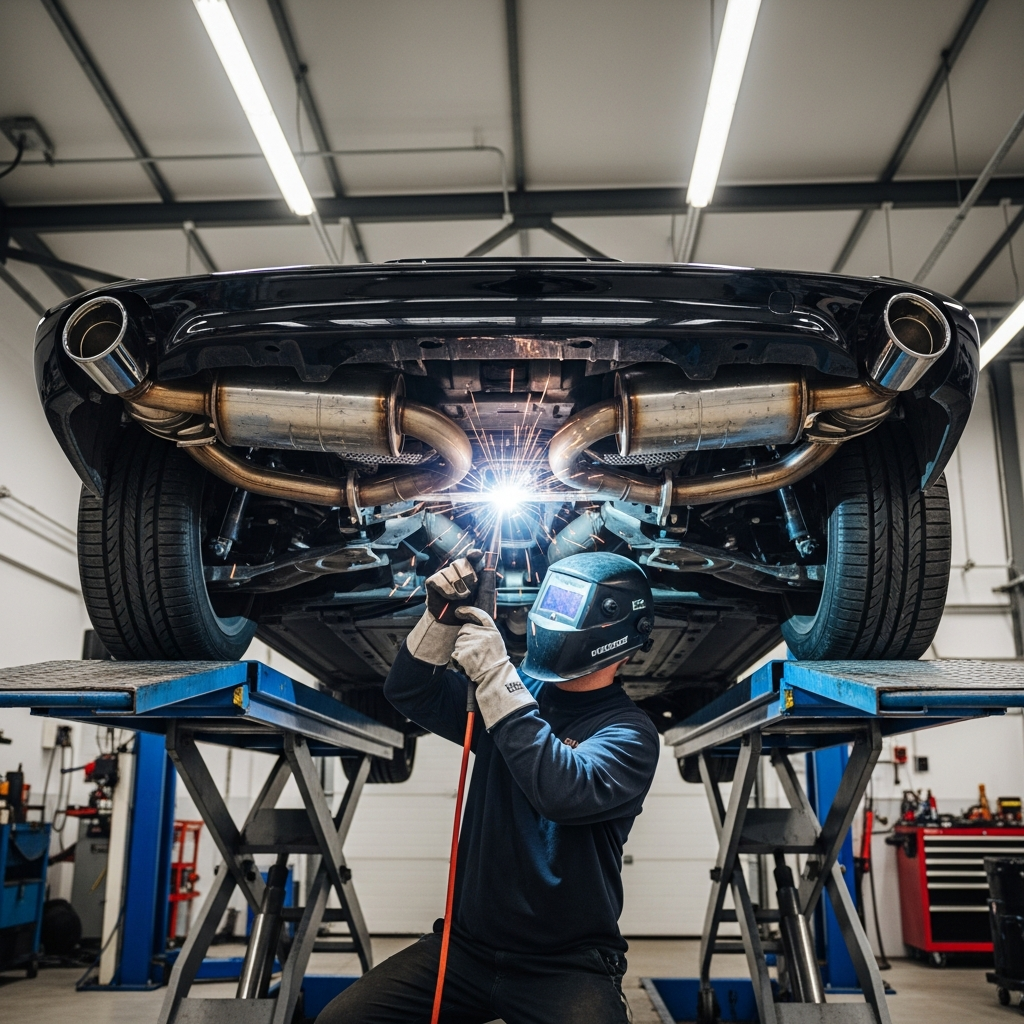
What a Stainless Steel Exhaust Repair Involves in the Workshop
The visible difference is small. The process difference is not.
- Different filler. Stainless needs a matched stainless filler wire or rod. Mild steel wire laid into stainless makes a joint that will corrode preferentially and fail early, and it is one of the most common reasons a “repaired” stainless system comes back.
- Different shielding gas. The gas mixes used for mild steel are wrong for stainless, and getting this wrong shows up as a dull, sooty, porous bead rather than a clean one.
- Far tighter heat control. Stainless carries heat away poorly and moves more as it cools. Too much heat and the pipe distorts, the joint discolours deeply, and the corrosion resistance in that zone is reduced — the exact spot you have just repaired becomes the weakest part of the system.
- Cleanliness that borders on fussy. Any mild steel dust, grinding debris or old wire brush contamination transferred onto stainless will start a rust spot on a surface that should not rust at all. Separate abrasives and separate brushes are not a nicety.
- More preparation for less welding. Getting a clean, tight, properly fitted joint before the arc is struck is most of the work. A gap filled with weld metal is a repair that cracks again.
There is a health dimension too, and it is a real one. The Health and Safety Executive notes that ozone is generated in particular when TIG welding stainless steels and aluminium, alongside the broader chronic risks that make welding fume something to be controlled rather than tolerated. That is one of several reasons structural and stainless work belongs in a properly equipped workshop rather than on a driveway.
Stainless Is Not Rust-Proof — It Is Rust-Resistant
A stainless system on a British car spends winter coated in road salt and, on short journeys, never gets hot enough to burn off the moisture inside it. Stainless copes with that far better than mild steel, but it is not immune.
Two things routinely start corrosion on stainless. The first is contamination: steel particles embedded in the surface from a kerb strike, a bracket, or a grinder used on ordinary steel. Those particles rust, and the stain looks as though the stainless itself has failed. The second is a poorly made previous weld, where the heated zone has lost some of its corrosion resistance and quietly becomes the sacrificial part of the system.
This matters when you are deciding between repairing and replacing. Surface staining is usually cosmetic. A crack running out of an old weld is not, and it will spread.
Where the MOT Sits in All This
The test does not care what your exhaust is made of. Under the DVSA inspection manual, an exhaust system with a major leak, or one that is insecure, is a Major defect — a straight failure, whether the pipe is aluminised steel or the most expensive stainless on the market.
What the material changes is your options for putting it right, and how long the fix should be expected to last. A well-made stainless repair on sound stainless is generally a long-term answer. A patch on a mild steel silencer that has thinned across a wide area is a short-term one, and any welder worth using will say so rather than take the work. Our guide to how long a welded repair realistically lasts covers what governs that lifespan.
Repair or Replace? A Straight Answer
Here is the view from the ramp, and it is not the view most parts sellers will give you.
- Stainless with a local crack or a failed bracket tab: repair, almost always. The pipe is fine; one small area is not.
- Stainless with a corroded, pitted section: cut that section out and let a new piece in, rather than building the hole up with weld.
- Aluminised or mild steel with a single pinhole in otherwise firm metal: a repair is reasonable and can buy real time.
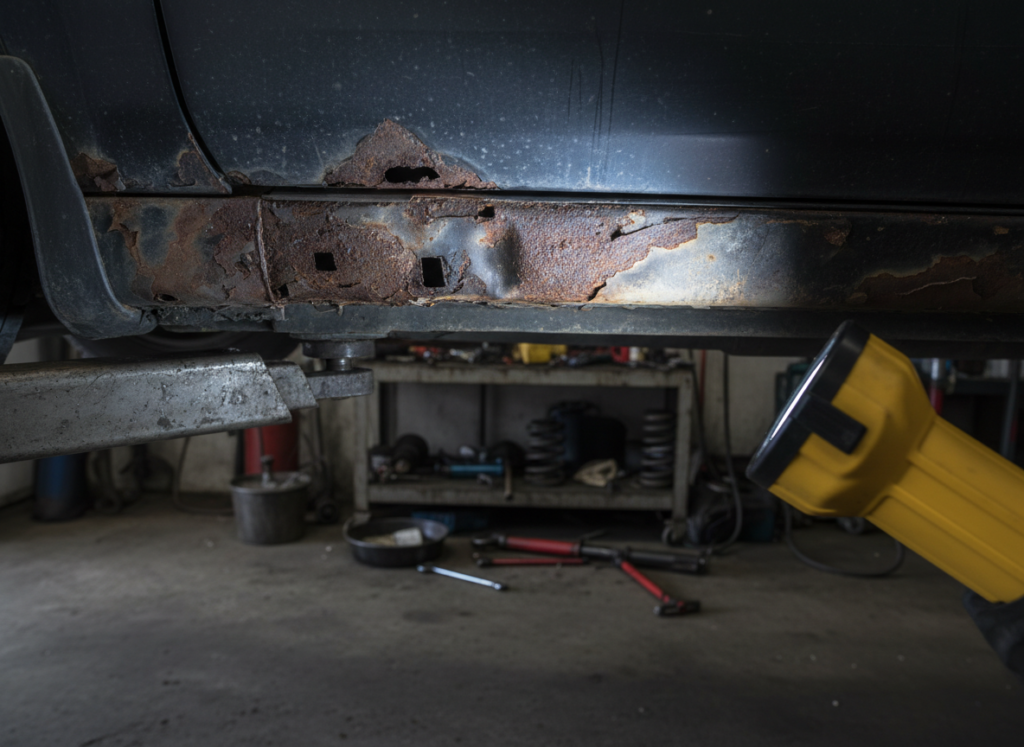
- Mild steel that flexes, flakes or sounds hollow across a wide area: replacement of that section. Welding to metal that has no thickness left is a repair that fails on the way home.
The wider comparison between the two routes is set out in our piece on when a section should be repaired and when it should be swapped. The material simply moves where that line sits.
If you would rather have someone look at it than guess from the noise, the exhaust and bracket repair service at Star Welding Mansfield starts with an assessment on the ramp, so the answer you get is based on the metal that is actually there.
Frequently Asked Questions
Can you weld stainless steel to mild steel on an exhaust?
It can be done with the right filler, and it is sometimes unavoidable where a stainless section meets an original mild steel pipe. It is not ideal. The joint between two dissimilar metals is where corrosion concentrates, so it should be positioned and protected deliberately rather than left as an afterthought. Where there is a choice, matching the material either side of the joint gives a longer life.
Why did my stainless exhaust crack when it is supposed to last forever?
Stainless resists corrosion, not stress. Heating and cooling cycles, engine movement and road vibration all act on the system, and if a mounting has failed or a bracket is holding the pipe too rigidly, that load has to go somewhere. It goes into the nearest joint. A crack in stainless is usually a mechanical story rather than a corrosion one, which is why fixing the mounting matters as much as fixing the pipe.
Is a stainless exhaust worth it on an older car?
It depends on how long you intend to keep the vehicle and what else is happening underneath it. On a car you plan to keep, stainless generally outlasts the alternative comfortably. On a vehicle with significant structural corrosion elsewhere, a long-life exhaust is rarely the most useful place to put the effort — and an honest assessment will tell you that before anything is ordered.
Can a stainless exhaust be repaired at the roadside or on a driveway?
Stainless work needs the right gas, the right filler, clean uncontaminated preparation and controlled heat — plus proper fume control. Those conditions are workshop conditions. Star Welding Mansfield is not a mobile service for exactly this reason: the repair either gets done properly on a ramp or it comes back.
How can I tell what my exhaust is made of before I book it in?
Start with a magnet on a cold system. Non-magnetic means stainless. Magnetic means mild steel, aluminised steel or a magnetic stainless grade, so it narrows things without settling them. Beyond that, look at the wall thickness and the welds: a thick-walled pipe with neat, evenly rippled beads is usually an aftermarket stainless system. A welder will confirm it in seconds once the car is up.
Exhaust Blowing? Get the Material Identified First
Knowing what your exhaust is made of changes the sensible answer, and it is the first thing worth establishing before anyone quotes you for a part you may not need. The coded welders at Star Welding Mansfield work on mild steel, aluminised and stainless systems at the workshop in Mansfield Woodhouse, Nottinghamshire, covering Mansfield, Sutton-in-Ashfield, Kirkby-in-Ashfield, Worksop and the surrounding Nottinghamshire area.
All work is carried out in the workshop, where the correct gas, filler and fume control are available — there is no mobile service, because a stainless repair done badly is worse than no repair at all.