How Car Rust Spreads and When Welding Repairs Are Needed
Rust is one of the most common reasons cars fail their MOT, and one of the most misunderstood problems drivers face. Many people assume rust is a cosmetic issue — something that looks bad but can wait. In practice, rust is a structural problem that spreads progressively, and by the time it is visible on the surface, it has often already worked its way through the metal underneath. This guide explains how car rust actually spreads, which parts of a vehicle are most at risk, and at what point welding becomes the only reliable solution.
At Star Welding Mansfield, rust repair is one of the most common reasons vehicles come through our doors. Our coded welders carry out sill repairs, floor pan repairs, wheel arch work, and structural welding — all jobs that typically begin with rust that was allowed to develop further than it needed to.
Rust is also the point where people start wondering whether the job belongs to a welder or a bodyshop. Our guide to car body repair in Mansfield sets out which damage needs cutting out and welding, and which is genuinely a panel-and-paint job.
How Rust Starts on a Car
Steel rusts when iron in the metal reacts with oxygen and moisture. On a car, this process starts wherever the protective coating — paint, underseal, or factory corrosion protection — has broken down or been compromised. That can happen through stone chips, scrapes, general wear, or simply age. Once bare metal is exposed to water and air, oxidisation begins.
In the UK, road salt used during winter months significantly accelerates corrosion. Salt acts as an electrolyte that speeds up the electrochemical reaction causing rust. Cars driven regularly on salted roads — particularly older vehicles without modern rustproofing — corrode faster than those kept in dry conditions. Areas that trap mud, moisture, or road grit are especially vulnerable.
The rust process is self-reinforcing. As iron oxide forms, it takes up more volume than the original metal, which creates pressure that forces the surrounding paint and protective coating to crack and lift. That exposes more bare metal, which then rusts in turn. This is why rust on a car appears to grow and expand even without any new damage — the chemistry drives it outward from the original point of attack.
Which Parts of a Car Rust First?
Rust does not spread evenly across a car. It concentrates in areas that hold moisture, trap road debris, or have seams and joints where factory protection is thinner. The parts of a vehicle that corrode most commonly include:
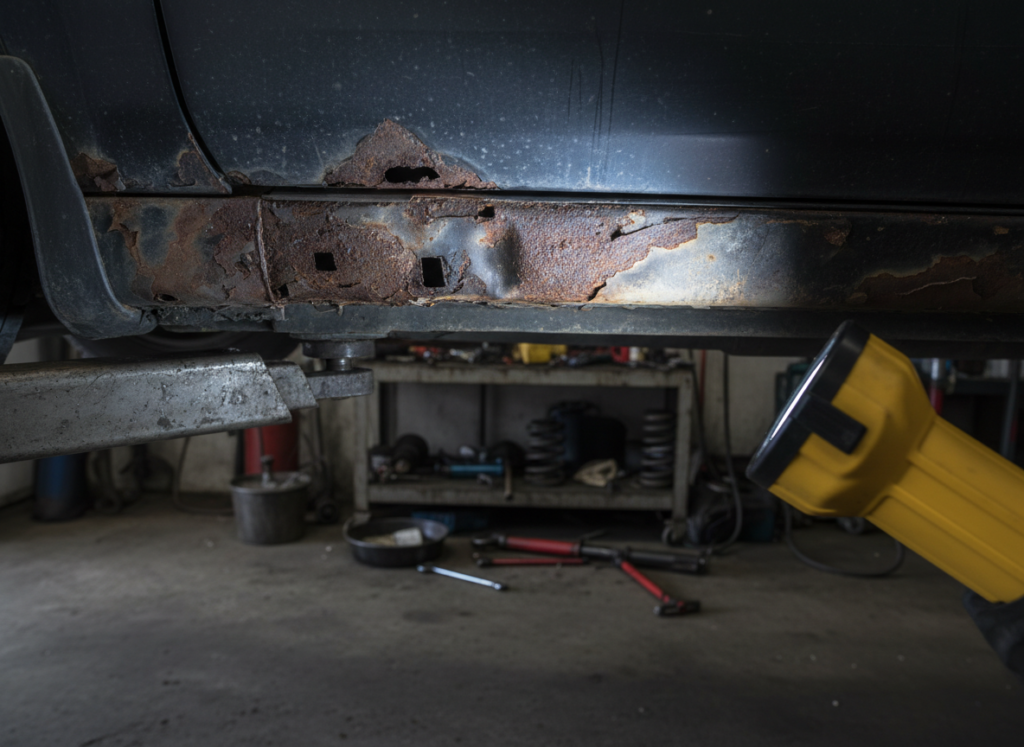
- Sills — the structural panels that run along the bottom of each door opening. Sills are directly in the firing line of road spray, and their box section design can trap water inside, corroding from within. Inner sill corrosion is often more advanced than the outer surface suggests.
- Wheel arches — the inner and outer arch panels take constant impact from road grit and retain mud. Once the coating breaks down, arch corrosion can spread quickly into the surrounding bodywork and structural sections.
- Floor pan — the underbody floor is exposed to moisture from above and below, and areas around drainage holes, carpet fixings, and seat mounts can corrode through where water pools.
- Chassis rails and crossmembers — structural members running along the underside of the vehicle. Corrosion here is a serious structural concern and is one of the most common reasons for MOT failure on older vehicles.
- Boot floor and spare wheel well — often overlooked until the rust has spread significantly, particularly if a boot seal has allowed water ingress over time.
- Around suspension mounting points — these areas carry significant load and any corrosion here is treated seriously by MOT testers.
For more on the types of repairs our coded welders carry out on sills, floor pans, and wheel arches, see our sill, arch, and floor pan repair service.
The Stages of Rust — From Surface Staining to Structural Failure
Rust progresses through recognisable stages, and understanding them helps explain why early intervention matters so much:
- Surface oxidisation — a light orange-brown staining on exposed metal that has not yet significantly degraded the metal surface. At this stage, the metal has not yet been weakened. Treatment with a rust converter or protective coating may be sufficient, depending on the location and extent.
- Scale rust — the surface has begun to pit and texture, with rust eating into the upper layers of the metal. The panel is beginning to lose thickness. Surface treatment may still help, but if this is on a structural area, a more thorough approach is needed.
- Penetrating rust — the rust has worked through the full thickness of the metal, creating perforations or thin spots. At this stage, treatment cannot restore the structural integrity of the panel. Welding is typically required: the affected area is cut back to sound metal and new metal is welded in.
- Structural compromise — the metal has corroded to the point where surrounding areas are also affected, and the structural integrity of the section has been significantly reduced. Larger repair sections are required, and in some cases the repair may be extensive.
The jump from stage 2 to stage 3 happens faster than most people expect, particularly in winter or in vehicles that see regular wet road conditions. A panel that looks like surface rust in October can be at penetrating stage by spring if it is not addressed.
What MOT Testers Look for When It Comes to Rust
The DVSA sets out specific requirements for what constitutes a fail on corrosion during an MOT. An MOT tester will check the underbody of the vehicle for corrosion in structural areas, and the standards are stricter than many drivers realise. Key areas that testers assess include:
- Sills — both inner and outer, where corrosion within a defined zone of load-bearing structure constitutes a fail
- Floor pan — particularly around seat mounting points, which are considered structural
- Chassis rails and subframe mounting points — any structural corrosion in these areas is a serious fail
- Wheel arch areas adjacent to suspension or steering components
- Any area where rust has perforated a panel that is defined as part of the vehicle’s structural zone
The important distinction is between corrosion on a non-structural body panel (which may not fail an MOT) and corrosion on a panel that forms part of the vehicle’s structural integrity. Testers are specifically looking for the latter. A car with surface rust on a door skin is in a different position to one with corroded inner sills or a perforated floor pan.
If your vehicle has failed an MOT for rust or structural corrosion, our MOT welding and rust repair service is specifically focused on carrying out the structural welding work needed to pass the retest.
Rust Treatment vs Welding — Which Is Appropriate?
This is one of the questions we get asked most often, and the honest answer is that it depends entirely on the stage and location of the rust.
Rust treatment — including rust converters, encapsulants, wax injection, and protective coatings — is appropriate for early-stage surface or scale rust that has not yet compromised the structural integrity of the panel. These products can slow or halt rust progression when applied correctly, but they cannot reverse or repair damage that has already occurred. They are a preventive or early-intervention measure.
Welding is required once rust has perforated the metal or thinned it to the point where it can no longer carry structural load. At that point, the only way to restore the panel’s integrity is to cut back the corroded section to sound metal and weld in a replacement section. There is no product that can restore the structural properties of metal that is no longer there.
One of the most common mistakes we see is drivers using filler or underseal to cover perforated panels rather than having them properly repaired. Filler is not structural. Underseal applied over rusted metal traps moisture and accelerates corrosion underneath the coating. These approaches delay the repair visually but make the underlying problem worse. By the time the car comes in for the welding job, the affected area is often larger than it would have been with earlier intervention.
Why Early Action on Rust Saves Time and Money
The economics of rust repair are straightforward: the further rust spreads, the more metal needs replacing, and the larger the repair. A perforated patch on an outer sill that is caught early may be a manageable repair. The same corrosion left for another year may have spread into the inner sill, the floor pan at the sill junction, and the wheel arch — tripling or quadrupling the size of the job.
On older vehicles in particular, rust has often been spreading for longer than the driver realises. What appears to be an outer surface problem has frequently progressed into the inner sections, which only becomes clear once the repair is started. This is not something any reputable workshop can predict precisely from a visual inspection alone — it only becomes fully apparent once the corroded outer panel is cut back and the inner sections can be assessed properly.
If you have noticed surface rust starting on sills, arches, or the underbody of your vehicle, getting it looked at sooner rather than later is almost always the more cost-effective decision. Our coded welders can assess the extent of the corrosion and advise on what is needed before the problem gets bigger.
For chassis and structural corrosion, see our chassis and structural welding service for more on what that type of repair involves.
Once rust has reached a structural panel, the next question is usually a financial one. We have set out how we weigh it up in our guide to whether it is worth welding an old car.
Get Your Vehicle’s Rust Assessed in Mansfield
If you have noticed rust starting on your vehicle, or if you have failed an MOT for corrosion and need welding repairs carrying out, Star Welding Mansfield can help. We are based in Mansfield Woodhouse and carry out structural rust repairs, sill and floor pan welding, wheel arch repairs, and MOT welding work for drivers across Mansfield and Nottinghamshire.
Bring the vehicle in and we will put it on the ramp, assess the corrosion properly, and give you an honest picture of what is needed.
If you own an older or classic vehicle and are planning restoration work, see our guide to classic car welding and restoration to understand what structural repairs typically involve.
Contact us to arrange a rust assessment at our Mansfield workshop