Corroded Suspension and Spring Mounts: Why They Fail an MOT and What Welding Involves
The MOT inspection manual does not test your spring mount by name. It tests the metal around it. Section 5.3.6 tells the tester to check the strength and continuity of the load bearing structure within 30cm of any sub-frame, spring or suspension component mounting — and if that structure is significantly reduced or inadequately repaired, it is a Major defect and the car fails.
That one sentence is why so many drivers fail on a part they have never heard of. Suspension mount corrosion repair is not really a suspension job. It is a structural welding job on the body or chassis that the suspension bolts to, and it comes with its own rules about how the repair is allowed to be made.
At Star Welding Mansfield we see spring pans, spring hangers and turret tops on the ramp every week. This guide explains where they rot, why the spring load turns a small hole into a structural problem, and what a proper repair looks like.
In Short: Why a Corroded Suspension Mount Fails
A suspension or spring mount fails an MOT when the load-bearing structure within 30cm of the mounting is weakened, holed, or has been repaired badly. Because that structure carries spring load, the only acceptable fix is new steel welded to sound metal. A plate lapped over the hole is not a repair — it is a second failure item.
Where Suspension and Spring Mounts Actually Rot
Suspension mounting points are not evenly at risk. The ones that fail share a shape: they face upwards, they are cupped or boxed, and they sit directly in the spray thrown off a wheel. Water and salt land in them and then have nowhere to go.
The four we cut out most often are:
- Rear coil spring pans and spring seats. The pan is a dish. It collects road grit, holds it damp against bare steel, and corrodes from the inside of the dish outwards. On hatchbacks and small vans this is by far the most common suspension-mount failure we see.
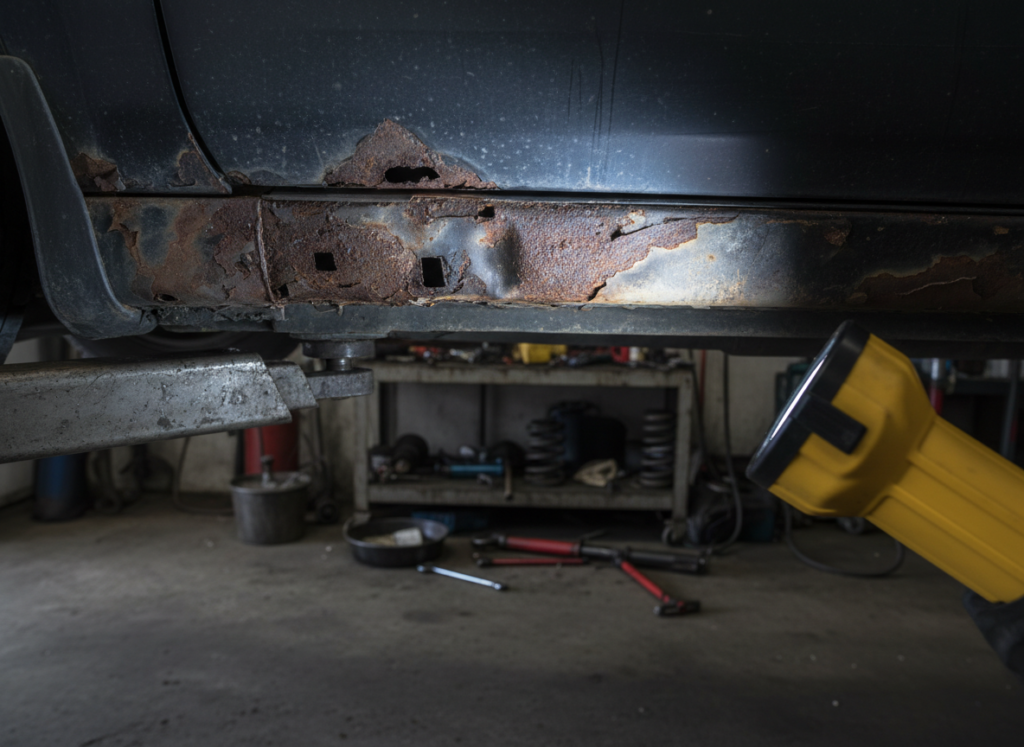
- Rear spring hangers and shackle mounts. On leaf-sprung vans, pickups and older 4x4s the hanger is a bracket welded to the chassis rail. Rot usually starts where the bracket meets the rail, which is exactly where you cannot see it without a torch and a probe.
- Front suspension turrets and strut tops. The turret is a pressing in the inner wing. Water runs down the strut, sits on the flat top of the turret under the bonnet seal, and works down into the seam.
- Sub-frame mounting points and the floor around them. The bolt may be fine. The captive nut and the floor panel it is welded into may not be.
This is not bad luck or bad build quality. DVSA’s own guidance flags it: thin gauge steel pressings are commonly used for suspension mountings, sub-frames and cross members, and they are prone to serious and often very localised corrosion that can be difficult to see. Localised is the key word. There may be nothing wrong for six inches either side of a hole you could put a screwdriver through.
Why the Spring Load Makes This Structural, Not Cosmetic
A rusty wheel arch is ugly. A rusty spring pan is different in kind, because the pan is doing a job every second the car is stationary as well as moving.
A road spring is permanently compressed. It is not resting on the pan, it is pushing against it, and that force has to be fed into the shell of the car through whatever metal the pan is welded to. Reduce the thickness of that metal and the load does not go away — it concentrates on what is left.
That is why suspension mounts tend to fail suddenly rather than gradually. Steel that has been quietly thinning for three winters gives way in one pothole, and the spring lets go through the floor or the arch. It is also why the tester’s finger-and-thumb check is a fair test: if you can flex it by hand, a loaded spring can certainly move it.
The corrosion itself almost always starts on the hidden face. By the time the paint on the visible side is bubbling, the steel behind it has usually been going for a while. We have written separately about how rust travels through a car’s underbody, and mounting points are the clearest example of the pattern.
What the MOT Rule Actually Says
The phrase that matters is prescribed area. It has a specific meaning, and it is broader than most drivers expect.
A prescribed area is any load-bearing part of the vehicle that a testable item is mounted to — brakes, steering, axles and suspension, and other tested equipment — plus any load-bearing or supporting structure or panelling within 30cm of that mounting location. So the tester is not only looking at the spring pan. They are looking at 30 centimetres of surrounding floor, rail, seam and reinforcement in every direction.
Within a prescribed area, corrosion is rejected if it has caused a hole in the metal, if the area does not feel firm when pressed with finger and thumb, or if a finger, thumb or the corrosion assessment tool makes a hole. There is no percentage and no measurement to argue about. It either holds up to a firm press or it does not.
Section 5.3.6 then sets the outcome. Load-bearing structure within 30cm of a sub-frame, spring or suspension mounting that is significantly reduced or inadequately repaired is a Major defect — a fail. Where it is weakened badly enough that control of the vehicle is likely to be affected, it is Dangerous.
Note the words or inadequately repaired. A previous repair that does not meet the standard is a failure in its own right, whether or not there is any remaining rust. That catches more cars than people realise.
This is the territory our chassis and structural welding service exists for, and it is worth understanding before you agree to any repair.

Why a Plate Over the Hole Will Not Pass
Here is where a lot of online advice goes wrong. Search for spring pan repair and you will find people describing a plate cut to shape, tacked over the rot, and painted. On a non-structural panel that might be acceptable. On a suspension mount it is not.
The standard is set out plainly. Repairs to structural components must be properly carried out and appear to be as strong as the original structure, using suitable materials, with any plating or welding extending to a sound part of a load-bearing member. Patch repairs must be continuously seam welded. Spot welds are only acceptable where the original panel was spot welded and the original section has been removed, and stitch or plug welding may be used in place of spot welding.
Three things follow from that, and each one rules out the quick fix:
- The rot has to come out. You cannot weld sound new steel to steel that is already thin. The repair has to reach metal that is genuinely solid, which usually means cutting further back than the visible damage suggests.
- Tacks are not enough. A patch held on by a handful of welds is not continuously seam welded, so it does not meet the standard however neat it looks.
- Filler, bonding and brazing are out. Gas brazing, soldering, adhesive bonding, fibre reinforcement and body filler are all explicitly unacceptable for repairs to load-bearing members. That includes the underseal-over-the-top approach, which hides the problem rather than fixing it.
Our view, plainly: if someone offers to sort a corroded spring mount quickly and cheaply without removing anything, they are describing a repair that is itself a failure item. It may get through one test with a tester who cannot see it. It will not hold the load.
The One Thing That Cannot Be Welded: the Spring Itself
This surprises people, so it is worth being clear about. You can weld the mounting. You cannot weld the spring.
The inspection manual lists welded repairs and the use of excessive heat on highly stressed components among the unsafe modifications that fail a spring outright. Appendix A goes further: welded repairs to highly stressed components such as steering and suspension arms, rods and levers are not normally acceptable at all.
There is a good reason. A coil spring is heat-treated steel, and its strength comes from that treatment. Put an arc anywhere near it and you have locally undone the metallurgy. It may look fine and then snap.
So a broken or badly corroded spring is a replacement, not a repair. A corroded spring seat, hanger or turret is a welding job. If a car comes to us with both, the welding is ours and the spring goes back on new. Anyone offering to weld a cracked road spring should be politely declined.
The same logic applies further out along the suspension. Where corrosion has attacked an arm or a rod rather than the structure it mounts to, the honest answer is a new component. Where it has attacked the sub-frame or the shell, that is weldable — we have covered how sub-frame corrosion is assessed and repaired in its own guide.
What the Repair Involves in the Workshop
Every job is different, but the sequence rarely is.
- Get to it and find the real edge. Wheel off, spring load released where needed, underseal and loose scale cleaned back. Probing tells us where sound steel starts — and it is almost never where the paint stops.
- Cut back to solid metal. The corroded section is removed entirely rather than covered. On a spring pan that often means taking the whole dish and part of the surrounding panel.
- Make the repair section. New steel is shaped in matching gauge so the finished mount reproduces the original form and thickness. On a spring seat the profile matters, because it locates the spring.
- Weld to sound structure. The repair is seam welded to metal that is genuinely load-bearing, so the load path through the mount is continuous again.
- Refit, check and protect. Spring and suspension components go back with the correct fixings, the mount is checked under load, then the repair is sealed and treated.
What changes the length of the job is what we find at step one. A single spring pan on an otherwise sound car is a contained repair. If the rot has run into a chassis rail, a floor section or the seam behind the mount, the repair has to follow it — because a weld onto thin steel is not a repair at all. We will always show you what we have found and explain what it means before going further.
Protection afterwards matters more here than almost anywhere else on the car, because the geometry that trapped the moisture in the first place has not changed. Our guide to protecting a repair once the welding is finished covers what we apply and why.
Frequently Asked Questions
Will a corroded spring mount always fail an MOT?
Not automatically — it depends on how far it has gone. Surface rust on a spring pan that still feels firm under finger and thumb is not a failure, though a tester may well mention it. It becomes a fail once there is a hole, the metal gives under a firm press, or a previous repair does not meet the standard.
Can a rear spring pan be repaired, or does the whole beam or axle need replacing?
In most cases it can be repaired. A spring pan is a pressing welded to a beam, subframe or floor, and a new section can be made and welded in without replacing the whole assembly. Replacement becomes the sensible call when the corrosion has spread well beyond the pan into the structure around it, or when the mount is part of a component that is highly stressed in its own right.
Is a corroded suspension mount dangerous to drive on?
It can be, and that is reflected in the test itself: where the structure around a spring or suspension mounting is weakened enough to affect control of the vehicle, the defect is graded Dangerous rather than Major. If a mount is holed or you can move it by hand, treat it as urgent and get it looked at rather than waiting for the next test.
Do I need a coded welder for a suspension mount repair?
The MOT does not require a certificate — it requires the finished repair to be as strong as the original and continuously seam welded to sound metal. Coding is not a legal box to tick; it is evidence that the person holding the torch has been tested against a standard. On a mount that carries spring load, that is the reassurance most people are actually looking for.
Can suspension mount welding be done at the roadside or at my home?
No. This is workshop work. The car needs to be raised, the suspension unloaded and the area properly prepared, and none of that is safe or achievable on a driveway. Star Welding Mansfield is a workshop-based business — vehicles come to us at Mansfield Woodhouse.
Book an Inspection at Star Welding Mansfield
If your car has failed or picked up an advisory for corrosion near a spring, sub-frame or suspension mounting, the useful next step is an honest look at how far it has gone. We will get it up, probe the area properly, and tell you what the repair actually involves — including if we think it is not worth doing.
We are B6 and 6G coded MIG and TIG welders based at 1 New Mill Lane, Mansfield Woodhouse, NG19 9BL, a short drive from Sutton-in-Ashfield, Kirkby-in-Ashfield, Worksop and Nottingham. All work is carried out in the workshop.
Contact Star Welding Mansfield to book an inspection or to talk through what your MOT sheet is telling you.
About the author: Reviewed and signed off by Star Welding Mansfield, B6 and 6G coded MIG and TIG welders specialising in MOT, chassis and structural vehicle welding across Nottinghamshire and north Derbyshire.
Published: 13 October 2026 · Last updated: 13 October 2026