How Long Does Exhaust Welding Last? Realistic Lifespan Explained
If you’ve got a blowing exhaust, a cracked pipe, or a snapped bracket, the big question is usually the same:
how long will an exhaust weld actually last?
The honest answer is: it depends. A properly prepared, correctly welded repair on solid metal can last
years. A quick “patch” on thin, rusty pipe might last a few weeks or months before it starts leaking again.
In this guide we’ll break down what affects exhaust welding lifespan in real UK driving conditions, what a good repair looks like,
and when replacement is the smarter option.
If you’re local, we’re Star Welding Mansfield and we handle everything from
exhaust welding and bracket repairs
to custom brackets and small fabrications.
If you want a quick quote, you can contact us here.
Quick Answer: Typical Exhaust Welding Lifespan
Most good exhaust weld repairs last 1–3+ years on a daily-driven car or van, and can last longer if the surrounding metal is healthy,
the repair is properly prepared, and the exhaust is supported correctly (no stress on the joint).
That said, exhaust systems live a hard life. They heat up and cool down constantly, get soaked in water and salt, and take knocks from speed bumps and potholes.
So the lifespan of a welded repair is mainly determined by the condition of the exhaust around the repair and how the repair is carried out.
- Best case: solid pipe + clean prep + correct weld + good hangers = long-lasting repair
- Worst case: thin, flaky rust + contamination + movement/stress = short-lived repair
If you’re weighing up welding vs replacement, our guide here is worth a read:
Exhaust Welding or Replacement?
What Makes Exhaust Welds Fail Early?
Most early failures aren’t because “welding doesn’t work”. They happen because the weld is being asked to hold together metal that’s already too far gone,
or because the exhaust is moving and flexing where it shouldn’t.
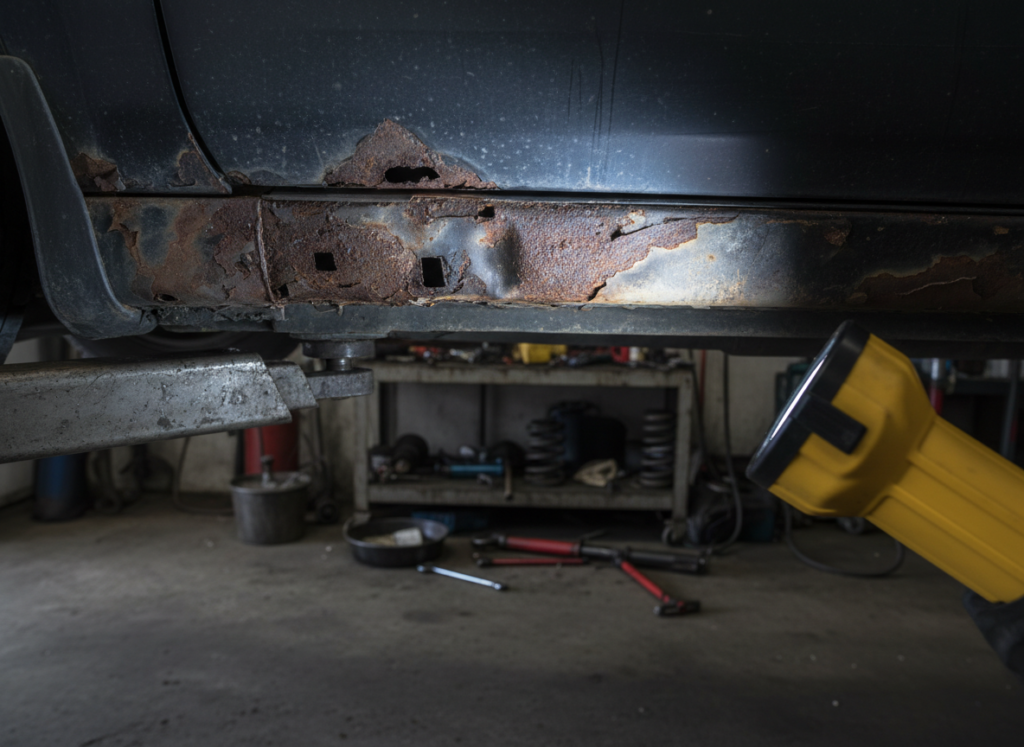
- Rust spread beyond the visible hole: the pipe looks repairable, but the metal around it is paper-thin
- Bad prep: welding over dirt, underseal, or corrosion leads to porous welds and leaks
- Heat cycling: repeated heating/cooling expands and contracts the metal, stressing weak areas
- Exhaust movement: broken hangers/brackets cause the system to swing and crack repairs
- Vibration: diesel vans and older engines can shake the system harder, especially at idle
- Knocks/impacts: speed bumps, kerbs, and rough roads can hit low sections
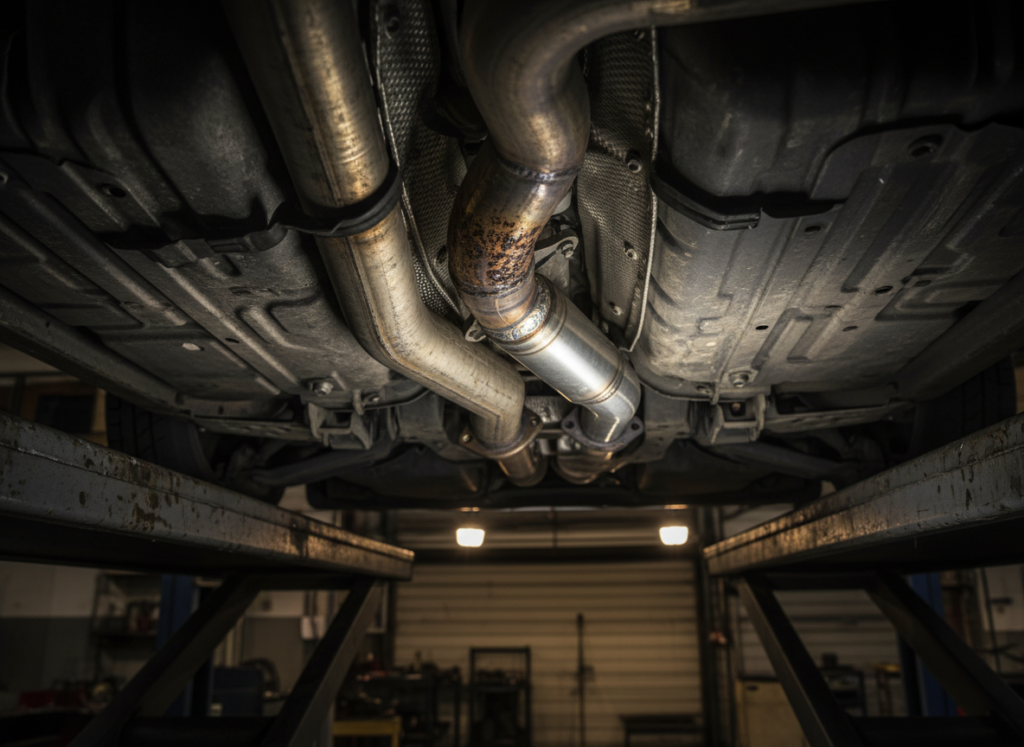
Brackets and hangers are a huge one. If a bracket is cracked or missing, the exhaust is basically “hanging” off the next joint.
That’s why we often repair the bracket at the same time as the leak.
(More on that here: Exhaust bracket welding repair.)
The 7 Biggest Factors That Affect Exhaust Welding Lifespan
1) How much solid metal is left
This is the number one factor. If the surrounding pipe is thin and flaky, the weld may “take” in the moment, but it won’t have a strong foundation.
A lasting repair usually requires cutting back to solid metal and welding in a sound section.
2) Where the damage is on the system
Some areas live a harder life than others. Repairs near flex sections, joints, and hangers can be more prone to movement.
Low points (mid-pipe sections) are more likely to get knocked. Rear sections can suffer from condensation and internal rust.
3) The type of repair (patch vs section replacement)
A small pinhole might be repairable, but if corrosion has spread, a patch becomes a temporary fix. Replacing a small section with good metal
is usually the longer-lasting option.
4) Exhaust support (hangers, rubbers, brackets)
Even a perfect weld can crack if the exhaust is moving. If hangers are perished or a bracket is snapped, the system will flex and pull at the repair.
If you’ve got rattling, knocks, or vibration, it’s worth checking the mounts.
5) Vehicle use and driving conditions
Short journeys are brutal for exhausts because they don’t get hot enough to evaporate condensation. That moisture sits inside the system and speeds up corrosion.
Add winter road salt and you’ve got the perfect recipe for early failure.
6) Previous repairs and “stacked patches”
If an exhaust has been patched multiple times, the metal is often thin and distorted. Welding onto old patches can be tricky and may not last.
In those cases, replacement of a section (or the back box/mid section) can be better value.
7) Quality of welding and preparation
Exhaust welding isn’t just “zap it and go”. Good repairs involve cleaning, cutting back, shaping metal properly, and welding in a way that seals the joint.
At Star Welding Mansfield, our welders are B6 and 6G MIG and TIG coded, and we focus on repairs that are safe, strong, and MOT-suitable.
Want to know more about us and how we work? See:
About Star Welding Mansfield.
How to Tell If an Exhaust Weld Repair Will Last (Before You Pay)
If you’re getting quotes, here are the practical signs you’re looking at a repair that has a good chance of lasting:
- The welder talks about cutting back to solid metal, not just covering the hole
- They check hangers and brackets (movement is a common cause of repeat cracks)
- They’re honest if the pipe is too thin and recommend replacement instead
- They can show examples of similar repairs (photos help)
- They explain what’s being repaired and why (no vague “we’ll just weld it”)
If you’re unsure, you can always bring it in for a look. Our exhaust service page is here:
Exhaust Welding & Bracket Repairs in Mansfield.
When Welding Is a Great Option (And When It Isn’t)
Welding is usually a great option when:
- The damage is localised (small crack, small hole, broken bracket)
- The surrounding metal is still solid
- A replacement part is expensive or hard to source
- You want a quick, cost-effective fix to stop a blow and pass the MOT
Replacement is usually better when:
- The pipe is thin and rusted along a long section
- There are multiple holes or multiple previous patches
- The back box or mid box is rotten internally (often noisy and weak)
- A repair would be “chasing rust” and likely to fail again soon
If you’re currently deciding between options, this comparison page is designed for exactly that:
Weld or Replace Exhaust?
Does Exhaust Welding Help With MOT Passes?
Yes—if it’s done properly. A blowing exhaust can fail an MOT for leaks, excessive noise, or emissions-related issues (depending on the vehicle and where the leak is).
Welding can restore the seal and reduce noise, and repairing broken brackets can stop movement that causes repeat leaks.
If your MOT failure involves corrosion elsewhere (sills, floor pans, chassis), we also handle:
MOT Welding & Rust Repair and
Chassis & Structural Welding.
And if you want a broader MOT welding overview, this post is already live:
MOT Welding Requirements & Costs (UK).
FAQs: Exhaust Welding Lifespan
-
Can an exhaust weld last the life of the car?
It can, if the rest of the exhaust is healthy and the repair is on solid metal. But if corrosion is widespread, the next weak point may fail later. -
Is welding a blowing exhaust a “proper” fix?
It can be. The key is preparation and whether the surrounding pipe is strong enough. A good repair seals the leak and restores strength. -
Why did my exhaust weld fail again?
Common reasons are thin metal around the repair, movement from broken hangers, or rust spreading beyond the repaired area. -
Do you weld exhaust brackets and hangers?
Yes—bracket repairs are one of the most common jobs we do. See:
Exhaust Welding & Bracket Repairs.
Got a rattle, blow, or bracket issue? Send a photo or bring the vehicle in—our advice is straightforward and honest.
Book an Exhaust Welding Repair in Mansfield
If your exhaust is blowing, rattling, or has a broken bracket, we can inspect it and recommend the best option—repair where it makes sense, replace where it doesn’t.
For exhaust-specific work, start here:
Exhaust Welding & Bracket Repairs.
If you’re ready to book in, you can contact us here or call:
We also work closely with our sister company Star Garage Mansfield
(and Lonestar Performance) for mechanical work, diagnostics, and keeping your vehicle road-ready.
Next reads that pair well with this post:
Weld or Replace Exhaust? and
Exhaust Bracket Welding Repair.