Chassis Welding Repairs UK: Safety, Rules, and Reality
Chassis welding repairs are often misunderstood. Some drivers are told chassis welding is illegal. Others believe any welded chassis will automatically fail an MOT. In reality, UK rules are more practical than most people realise, but the quality of the repair matters more than the fact that welding has been carried out.
This guide explains the safety considerations, MOT rules, and real-world expectations around chassis welding repairs in the UK. It’s written by the coded welders at Star Welding Mansfield, based on structural repairs we complete every week.
What Is a Vehicle Chassis?
The chassis is the structural backbone of a vehicle. On older vehicles and many vans, it is a separate frame that supports the body. On most modern cars, the chassis structure is integrated into the body shell, often referred to as a monocoque design.
Chassis components include rails, crossmembers, mounting points, and reinforcement sections. These parts carry suspension loads, protect occupants in a collision, and maintain alignment during driving.
When corrosion or damage affects the chassis, the vehicle’s strength and safety can be compromised, which is why repairs must be done properly.
Is Chassis Welding Legal in the UK?
Yes. Chassis welding is legal in the UK when carried out correctly. There is no law that bans welding repairs to chassis or structural areas.
What matters is whether the repair restores strength and meets MOT safety requirements. Poor-quality welding, plating over rust, or weakening the structure can lead to MOT failure or safety concerns, but welding itself is not prohibited.
In fact, professional chassis welding repairs are common on older vehicles, 4x4s, commercial vans, and classic cars.
What the MOT Test Looks for on Chassis Repairs
During an MOT, testers assess whether the vehicle’s structure is strong and safe. They do not automatically fail a car just because welding has been done.
A welded chassis repair may fail an MOT if:
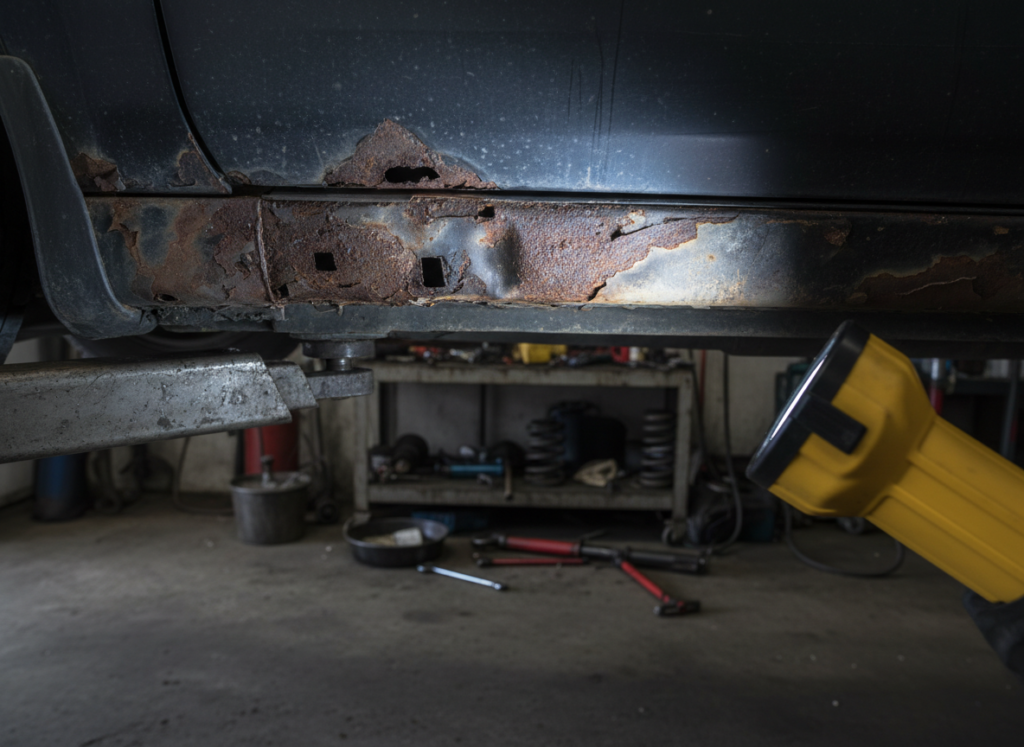
- Rust has been left behind the repair
- Thin or incorrect steel has been used
- Welds are incomplete, cracked, or poorly finished
- Sharp edges pose a safety risk
- The repair weakens the original structure
Conversely, a well-executed repair that restores strength will normally pass without issue.
See our approach to compliant chassis and structural welding.
MOT Welding Requirements: What the Rules Actually Say
A welded structural repair meets MOT requirements when it is as strong as the original structure, uses suitable material and extends into sound metal. Patch repairs must be continuously seam welded, unless the original joint was spot welded and the old section has been removed. Brazing, soldering, bonding and filler are not accepted on load-bearing members.
The rules are strictest in what the DVSA calls prescribed areas: the load-bearing parts that testable items such as brakes, steering, suspension and seat belts mount to, plus any load-bearing or supporting structure within 30cm of that mounting point. In a prescribed area the tester rejects corrosion that has holed the metal, an area that does not feel firm under finger and thumb pressure, or metal that gives way under the corrosion assessment tool.
- Seam welding: patch repairs must be continuously seam welded. Spot welds are only accepted where the original panel was spot welded and that section has been removed; stitch or plug welding can replace them.
- Sound metal at the edges: plating or welding must extend to a sound part of the load-bearing member, which is why rust is cut back rather than covered over.
- No substitutes on structure: gas brazing, soldering, adhesive bonding, fibre reinforcement and body filler are all unacceptable on load-bearing members.
- Outside prescribed areas: a defect is only failed where braking or steering is affected by misalignment, or overall structural strength or continuity is significantly reduced.
These rules are set out in Appendix A of the DVSA MOT inspection manual, and they are the standard we work to on structural repairs.
Common Causes of Chassis Damage
Chassis damage is not always the result of accidents. Many issues develop slowly over time.
- Long-term corrosion from road salt and moisture
- Water trapped inside box sections
- Impact damage from kerbs or road debris
- Overloading commercial vehicles
- Poor previous repairs
Vans and pickups are particularly vulnerable, as their chassis is often exposed and carries heavier loads.
Why DIY or Patch Chassis Repairs Are Risky
Chassis welding is not an area for shortcuts. Patch repairs that simply cover rust may pass visually at first but often fail later inspections or crack under load.
Risks of poor chassis welding include misalignment, reduced crash protection, and suspension mounting failure. These issues may not be obvious until they cause handling problems or serious safety concerns.
For this reason, professional coded welders are essential for structural work.
How Professional Chassis Welding Repairs Are Carried Out
At Star Welding Mansfield, chassis repairs are carried out using a methodical approach designed to restore original strength.
- The damaged area is fully exposed and assessed
- All corrosion is cut back to solid metal
- Correct thickness steel is selected
- Repairs are fully seam welded
- Structural shape and alignment are maintained
- Protective coatings are applied after welding
This ensures the repair is safe, durable, and MOT-compliant.
Does Chassis Welding Affect Insurance or Resale?
Professionally repaired chassis welding does not automatically reduce a vehicle’s value or invalidate insurance. Problems usually arise when repairs are poorly documented or obviously substandard.
For peace of mind, it’s sensible to keep records and photos of structural repairs. This demonstrates that work was carried out correctly if questions arise later.
FAQs: Chassis Welding Repairs
- Is chassis welding safe?
Yes, when done correctly by experienced coded welders. - Will my car pass an MOT after chassis welding?
Yes, provided the repair restores strength and meets MOT standards. - Can badly welded repairs be fixed?
Often yes, but the old repair usually needs removing first. - Do you repair chassis rails and crossmembers?
Yes, we handle a wide range of structural welding repairs.
Book a Chassis Welding Inspection in Mansfield
If you’ve been advised your vehicle needs chassis welding, or you’re unsure about an MOT failure, we can inspect the damage and explain the options clearly. You’ll get honest advice and proper repairs.
Contact us here or call:
You can also view recent structural welding projects to see real chassis repairs.