Chassis Welding: What Happens During the Inspection and Repair Process?
Chassis welding is among the most safety-critical work carried out on any vehicle. The chassis forms the structural foundation of the car — the point to which the suspension, engine mounts, and body panels ultimately connect. When it is damaged by rust or impact, the consequences for handling, safety, and MOT compliance can be serious.
This guide explains what chassis welding actually involves, how a specialist workshop approaches the inspection, what the repair process looks like, and when chassis damage genuinely needs a coded welder rather than a patch or temporary fix.
What Is the Chassis and Why Does It Matter?
The chassis is the structural frame of the vehicle. On traditional body-on-frame vehicles (many vans, pick-ups, and older cars), the chassis is a visible ladder or box-section frame that sits beneath the body. On modern monocoque cars, where the body and structure are integrated, the structural members include the floorpan, sill sections, inner sills, chassis rails, and subframe mounting points.
Regardless of construction type, the chassis carries the loads of acceleration, braking, cornering, and kerb impacts. Structural damage or corrosion in these areas compromises how the vehicle behaves and may make it unsafe to drive or impossible to pass an MOT.
Chassis welding is not a job that should be approached casually. It requires proper assessment of the damage, understanding of the load paths through the structure, and welds that genuinely restore structural strength — not just fill a gap.
What Causes Chassis Damage That Needs Welding?
The two main causes of chassis damage requiring welding are corrosion and impact.
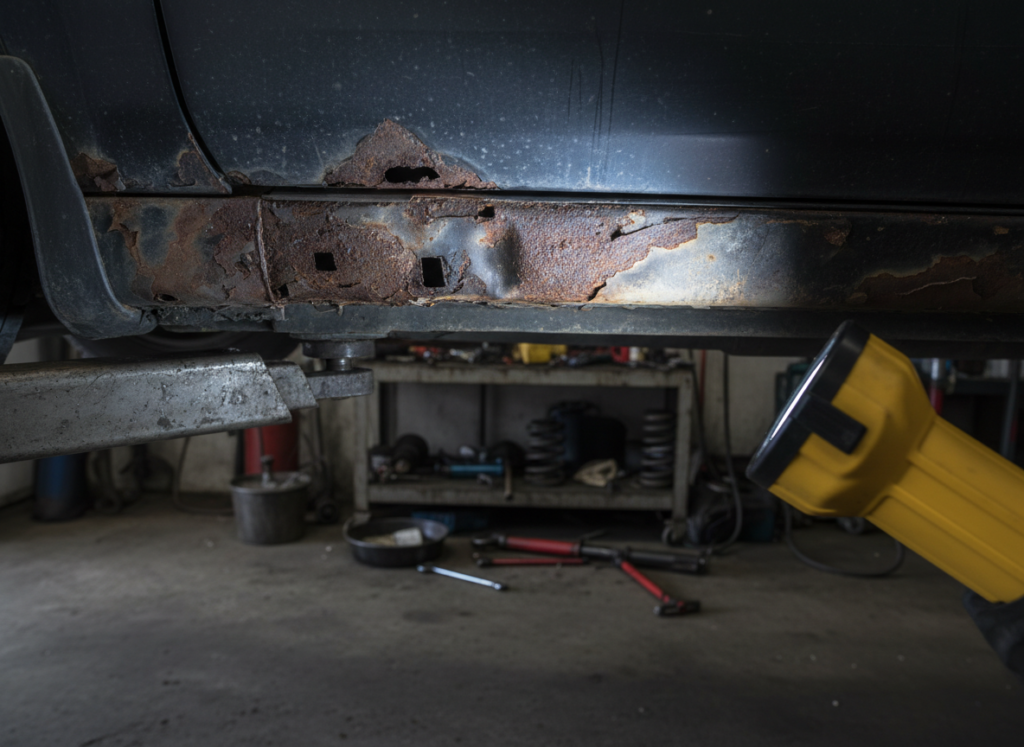
Corrosion is the most common. Road salt, standing water, and compromised underbody protection allow moisture to penetrate the steel over time. Chassis rails, crossmembers, and subframe mounting points can all corrode from the inside out, meaning the damage may be more extensive than it appears on the surface. By the time rust is visible on the exterior of a chassis section, the metal inside may already be significantly weakened.
Impact damage can occur from road hazards, kerb strikes, pot holes, or collisions. Even a low-speed impact can distort or crack chassis components, particularly if the vehicle hits something with a concentrated load — a large kerb, a deep pot hole at speed, or a head-on impact that transfers force directly into the front chassis legs.
In both cases, the damaged section cannot simply be left and expected to hold. Structural compromise in the chassis affects the safety of everyone in the vehicle.
What Does the Inspection Involve?
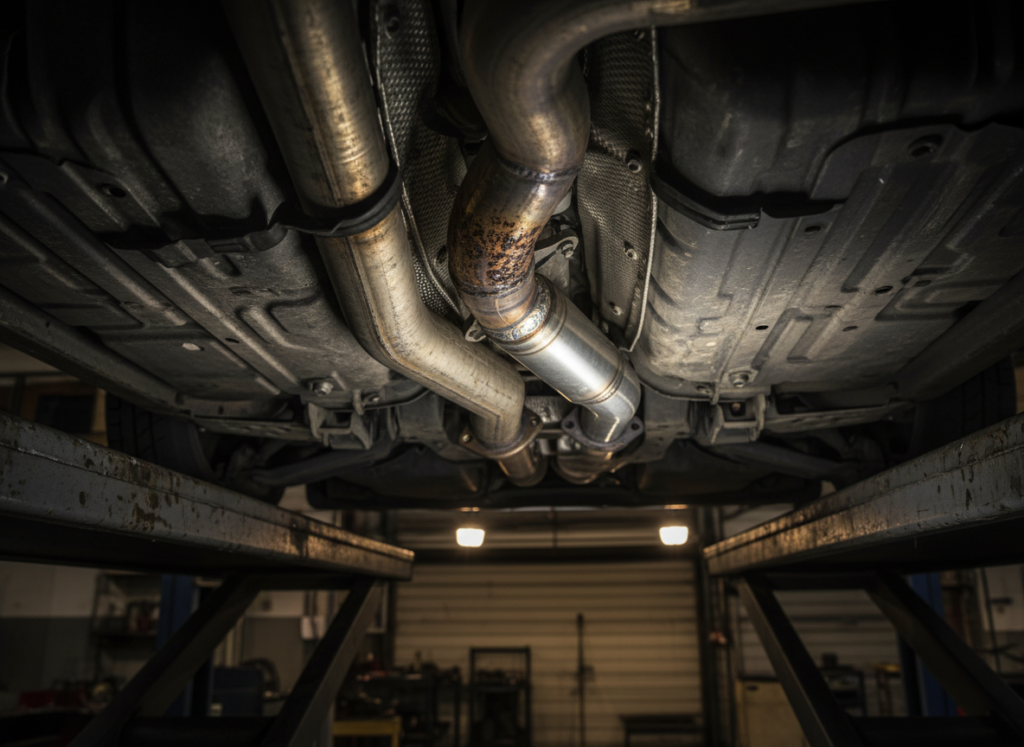
A proper chassis inspection requires the vehicle to be raised on a ramp so the underside can be examined carefully. A visual inspection alone is not sufficient for corrosion damage — an experienced welder will probe suspect areas to test the actual condition of the metal beneath any surface scale or underseal.
During the inspection, a specialist will typically check:
- The main chassis rails or structural sill sections for rust penetration or cracking
- Crossmembers and outriggers for corrosion, particularly at weld seams where water tends to collect
- Subframe mounting points and their surrounding metalwork
- The area around suspension mounting points, which carry high cyclic loads
- The floorpan and inner sill sections on monocoque vehicles
- Any section that has been previously repaired or patched
The purpose of the inspection is not just to identify the visible damage — it is to understand the full extent of the problem before deciding on the scope of repair. A professional workshop will not begin work without this step.
What Does a Chassis Welding Repair Involve?
Once the extent of the damage is clear, the repair process begins. For corrosion damage, this typically follows these steps:
- The damaged section is cut back to solid, clean metal — not just to where the surface rust ends, but to where the steel is genuinely sound and capable of holding a weld
- A repair section is fabricated in the correct profile and steel gauge to match the original structure
- The repair section is fitted and welded in, with full penetration welds rather than surface tacks
- The weld area is dressed and finished appropriately
- Corrosion protection is applied to the repair and surrounding area to reduce the risk of future deterioration
For impact damage, the process may also involve straightening distorted sections before welding, or in more severe cases, replacing a chassis section entirely with new steel.
The critical point throughout is that the repair must restore the structural performance of the original component — not simply close a gap or cover a hole.
Why Does Chassis Welding Require a Coded Welder?
Coded welders have demonstrated their welding competency to a recognised standard through formal testing and certification. For structural welding on vehicles — and in particular for safety-critical work on chassis components — coded welding matters.
An uncoded weld on a structural component may look acceptable on the surface but have inadequate penetration, incorrect fusion, or porosity that weakens the joint. On a cosmetic part, this might cause a visual defect. On a chassis section, it could cause a structural failure under load.
This is not a theoretical concern. MOT testers are experienced at identifying previous repairs that have been carried out to a poor standard, and a sub-standard chassis weld can result in an immediate advisory or outright failure on the grounds of structural adequacy — even if the weld appears visually complete.
Chassis Welding and the MOT
Chassis and structural components fall within the scope of the MOT test. Testers check for corrosion, cracking, and distortion in load-bearing areas of the underbody. Rust that has penetrated through a chassis section, or crash damage that has deformed a structural member, will typically result in a failure.
If a vehicle fails an MOT for chassis-related structural issues, the repair needed is not a temporary fix — it is a proper weld repair using appropriate materials and methods. An MOT tester carrying out a retest will check the repair thoroughly, and a poorly executed patch is unlikely to satisfy them.
Getting the repair done properly the first time, by a specialist who understands what the MOT tester is looking for, is always the better approach.
How Long Does a Chassis Repair Take?
This varies considerably depending on the extent of the damage and the complexity of the repair. A single rusted crossmember section on an accessible part of the chassis might be completed in a few hours. Extensive corrosion to multiple chassis sections, or impact damage that requires fabricating a bespoke repair section, will take significantly longer.
The workshop should be able to give you a realistic time estimate once the inspection is complete and the scope of work is defined. Attempting to rush chassis welding — particularly cutting back and fabrication steps — compromises the quality of the result.
Chassis and Structural Welding in Mansfield
At Star Welding Mansfield, our team carries out chassis and structural welding repairs on cars, vans, and light commercials. We carry out a proper inspection before any work begins, and we will give you a straight assessment of what the repair involves and whether it makes sense for your vehicle.
Our chassis and structural welding service is carried out by experienced coded welders at our Mansfield Woodhouse workshop. We also handle related structural work including sill, arch and floor pan repairs and MOT welding and rust repair.
If your vehicle has a known chassis problem — or you have failed an MOT for structural rust or damage — contact Star Welding Mansfield to arrange an inspection.