MOT Welding Requirements Explained: What Testers Really Look For
Failed your MOT for corrosion or “inadequate repair”? You’re not alone. Rust and structural corrosion are some of the most common reasons vehicles fail an MOT in the UK—
especially on older cars, vans, and campers.
The confusing part is that people often hear “it needs welding” without being told what the tester is actually looking for, or what makes one repair pass and another fail.
In this guide, we’ll explain MOT welding requirements in plain English: the areas testers focus on, what counts as a proper repair, and how to avoid repeat failures.
We’re Star Welding Mansfield. If you need MOT-standard repairs, start here:
MOT Welding & Rust Repair.
You can also contact us for a quote.
Quick Answer: What Is “MOT Welding”?
MOT welding means repairing corrosion or damage on structural parts of the vehicle using welding, so the vehicle meets MOT safety standards again.
The key is that the repair must restore strength and be carried out on sound metal—not just cover up rust.
MOT testers aren’t judging how pretty a weld looks. They’re checking whether the vehicle’s structure is safe and whether corrosion has weakened critical areas.
If the structure is compromised, it’s a safety issue—especially in a crash or heavy braking.
What MOT Testers Really Look For With Corrosion
The MOT focuses on corrosion in places that affect safety: steering, suspension, braking, seatbelts, and the vehicle’s structural integrity.
Testers will look for rust that has caused:
- Holes (perforation) in structural areas
- Severe thinning or flaking metal that’s clearly weakened
- Insecure mount points (e.g., seatbelt mounts, suspension mounts)
- Previous repairs that are insecure, poorly attached, or hiding corrosion
A common misconception is that “surface rust” fails an MOT. Light surface corrosion usually isn’t a fail on its own.
The problem is when rust becomes structural—where it affects strength or mounting points.
The “30cm Rule” Explained (In Plain English)
You’ll often hear about the “30cm rule”. In simple terms, corrosion is taken much more seriously if it’s within roughly 30cm of a safety-critical mounting point.
That includes areas like:
- Seatbelt anchor points
- Suspension mounts and subframe mounts
- Steering components and mounts
- Body mounts on certain vehicles
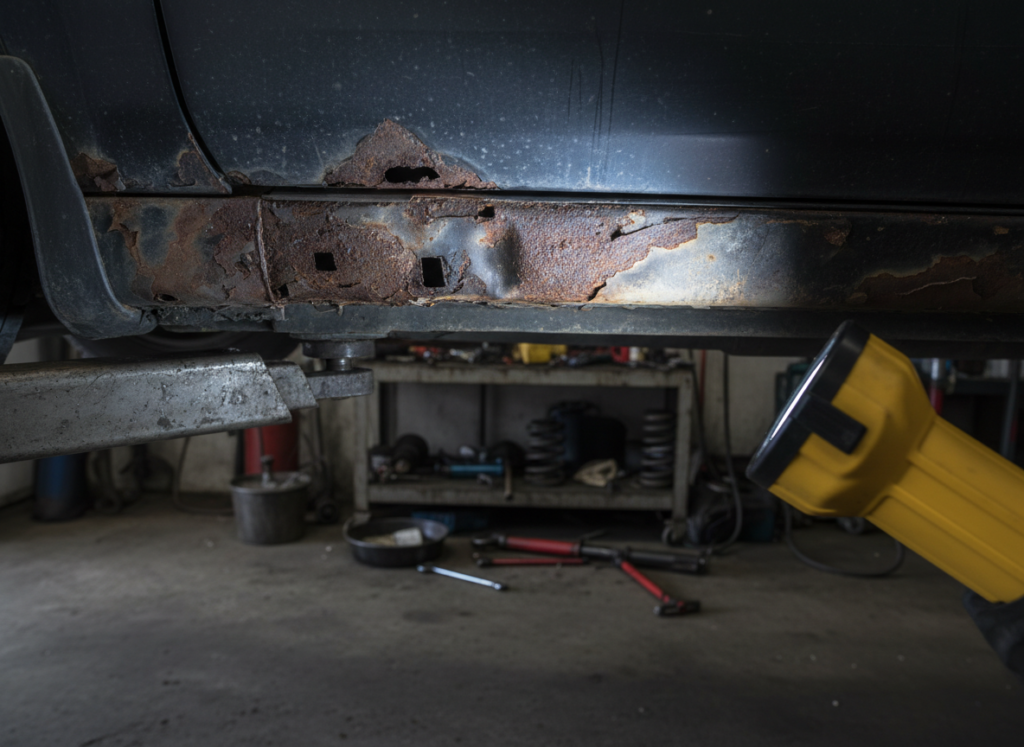
This is why sill corrosion can be an MOT fail even if the hole looks “small”. If it’s near a jacking point, seatbelt mount, or suspension area,
the tester has to treat it as a structural issue.
If you want to understand the typical repair areas, see:
Sill, Arch & Floor Pan Repairs and
Chassis & Structural Welding.
Common MOT Fail Areas That Often Need Welding
In the real world, these are the areas we most often see flagged on MOT failure sheets for welding and corrosion repairs:
- Sills: especially near jacking points and seatbelt areas
- Floor pans: under front footwells, rear passenger areas, and load areas on vans
- Wheel arches: inner arch corrosion spreading into structural sections
- Chassis rails / box sections: particularly on vans, pickups, and 4x4s
- Crossmembers: where road salt and water sit
- Seatbelt mounts: corrosion around anchor points is treated seriously
- Suspension mounting points: any weakness here is a major safety concern
If you’ve failed on any of the above, it’s usually worth getting the vehicle assessed properly rather than guessing.
You can book in via our contact page.
What Counts as a Proper MOT Welding Repair?
A proper MOT welding repair isn’t about making the hole disappear—it’s about restoring strength safely.
In practice, that usually means:
- Cutting back to solid metal: all weak, flaky corrosion removed
- Using suitable steel thickness: matched to the original structure (not thin sheet for structural areas)
- Correct fit-up: repair section shaped to sit properly, not “bridged” with gaps
- Secure welding: continuous welds where required, with proper penetration
- Protection: sealing and corrosion protection to slow rust returning
At Star Welding Mansfield, all welding is carried out by B6 and 6G MIG/TIG coded welders.
That matters because structural repairs need skill, control, and consistency—especially on thin automotive steel.
Learn more here: About Us.
What Causes “Repeat MOT Fails” After Welding?
The frustrating scenario is: you pay for welding, then it fails again next year—or even fails the retest.
The most common reasons are:
- Rust left behind: corrosion wasn’t fully removed, so it continues spreading under/around the repair
- Welding onto weak metal: the patch is attached to thin steel that later breaks away
- Repair too small: only the visible hole was covered, but surrounding metal was also compromised
- Poor sealing/protection: moisture gets in and corrosion returns quickly
- Hidden corrosion: inside box sections or behind seam sealer/underseal
If you want a practical DIY check before your MOT, this post is useful:
How to Spot MOT Welding Failures Before Your Test.
Can You “Just Plate Over” Rust for an MOT?
This comes up a lot. If rust is present, simply plating over it is rarely a good idea—and in many cases, it’s exactly what leads to repeat failures.
A plate can look fine from the outside, but if corrosion is still active underneath, it keeps spreading.
The goal should always be: remove the corrosion, repair properly, then protect the area. That’s how you get a repair that lasts and keeps passing year after year.
FAQs: MOT Welding Requirements
-
Will surface rust fail an MOT?
Usually no. Surface rust becomes an issue when it causes holes, severe thinning, or weakness in structural/safety-critical areas. -
Do welds have to look perfect to pass?
Testers focus on security and strength. A repair must be properly attached and restore integrity. “Pretty” isn’t the point—safe is. -
Can I drive after failing an MOT for corrosion?
Only to and from a pre-booked repair or retest, and only if the vehicle is still roadworthy. If in doubt, don’t risk it—get advice. -
What areas do you repair most often?
Sills, arches, floor pans, jacking points, seatbelt mounts, chassis rails, and structural sections.
See: All Services.
Book MOT Welding & Rust Repair in Mansfield
If you’ve failed an MOT for corrosion, or you want a pre-MOT check, we can assess the vehicle and quote honestly on the best repair approach.
Start here: MOT Welding & Rust Repair.
To book in, contact us here or call:
We also work closely with our sister company Star Garage Mansfield
(and Lonestar Performance) for mechanical repairs and diagnostics.